2025 · Documentation · In progress
frobou-documentor
A block-based document editor with workspaces and subdocuments, and an MCP server through which AI agents read the documents and, once the user confirms, write new ones.
- Role
- Design and development
- Period
- Oct 2025 — present
- Stack
- Angular · Docker · LLM · MCP · NestJS · PostgreSQL · TypeScript
- Team
- Solo, with AI agents
The problem
AI agents write documentation well, but what they produce tends to end up in a stray file in the repository or lost in the conversation. And giving an agent write access to the place where the notes live calls for care: it must not save anything nobody asked for.
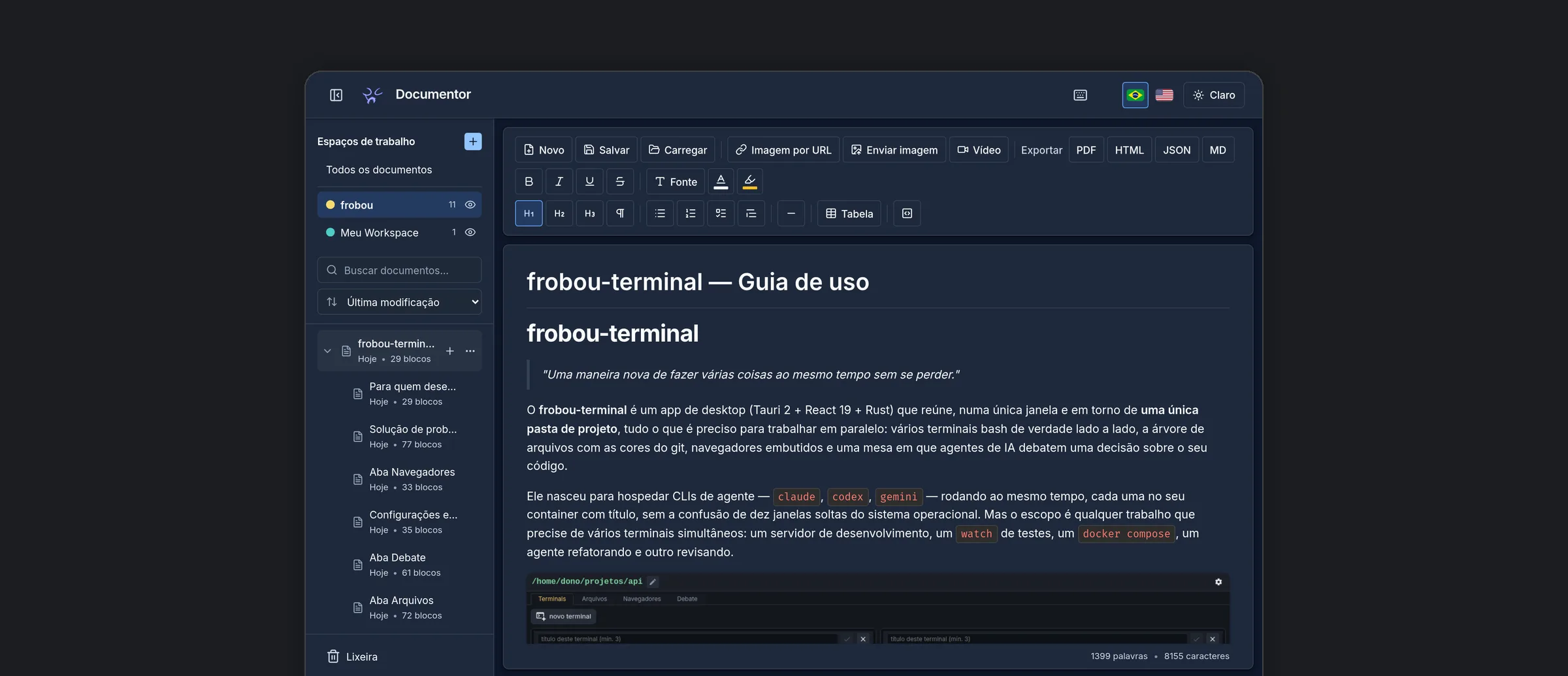
frobou-documentor is a block-based document editor, with its data in its own PostgreSQL, that serves an MCP for agents: they read freely and write only once the user confirms. The screens below come from the app running locally, with a guide an agent wrote through that MCP. The interface is in Portuguese; the app also has an English one.
The editor
The editor is TipTap, on top of ProseMirror: headings, lists, task lists, quotes, styled tables, code blocks highlighted by language, images uploaded or by URL, with size and alignment, and YouTube and Vimeo videos. Text takes bold, italic, underline, strikethrough, color, highlight and font.
A slash («/») on an empty line opens the block menu, which narrows down as you type, and Alt+Shift with the arrows moves the current block up or down.
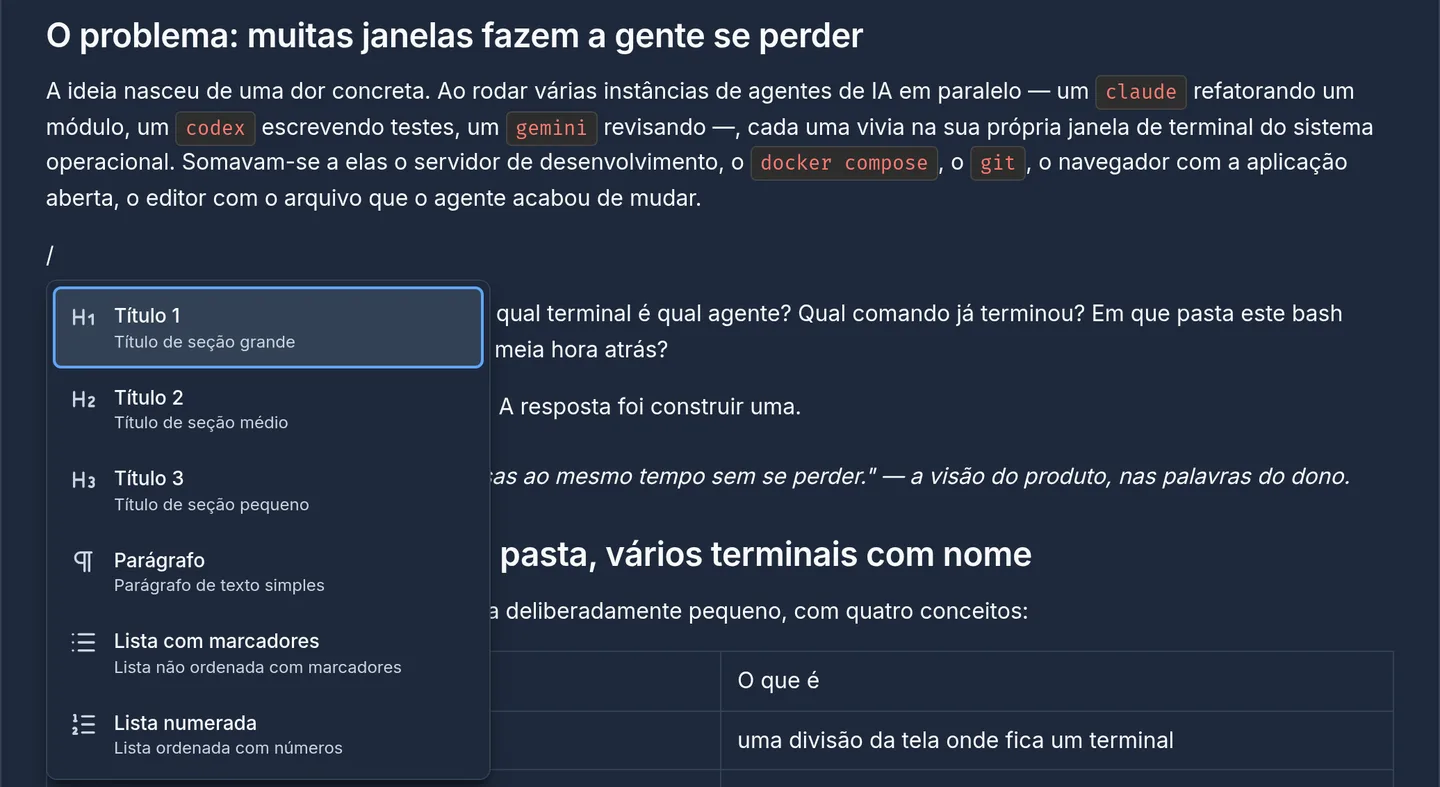
The document saves itself two seconds after the last change, and exports to PDF, HTML, JSON or Markdown.
Workspaces and subdocuments
Documents live in workspaces, each with its own color, and a workspace can have its documents hidden from the sidebar. Each document can have subdocuments: the sidebar shows the tree in the order chosen by hand, with drag and drop, and a document that moves to another place or workspace takes its subdocuments along. Search goes by title, and the list can also be sorted by last change, by creation or by title. What goes to the trash can be restored.
An MCP for agents
The backend serves an MCP server, built with the official TypeScript SDK, over Streamable HTTP. It ships turned off; once on, it requires an access token and, by default, only answers the machine it runs on. Through it, an agent such as Claude Code lists the workspaces and the tree, searches documents by title and reads each one as Markdown, with its sections and its version.
claude mcp add --transport http documentor http://localhost/api/v1/mcp \
  --header "Authorization: Bearer <token>"
Writing is another matter. Creating one document or several, changing a document, creating a workspace and moving a document all wait for the user to confirm in the agent's client: a form shows what will be written and where, and the agent has no way to answer it by itself. Declining or closing the form writes nothing, and the agent is told which of the two happened. A client that cannot show that form can only read. No tool deletes anything, and the server's instructions tell the agent to write only when the user asks, never to save notes or summaries on its own initiative.
- A whole guide at once. A document and its subdocuments go in a single call, with one confirmation that shows the whole tree, and either all of them are created or none.
- No overwriting. A change to a document carries the version the agent read: if the document changed since, nothing is written. It can replace a single section, by its heading, and the confirmation shows the before, the after and what is lost, such as colors and highlights that Markdown cannot write.
- Screens in the document. To add images, the agent gets a temporary address, good for 15 minutes and up to 50 images, and sends the files with a plain POST. An image no document uses is deleted after a day.
- The editor keeps up. If the agent changes the document open in the editor, coming back to the window reloads the new version, unless there are unsaved edits: then a warning says so.
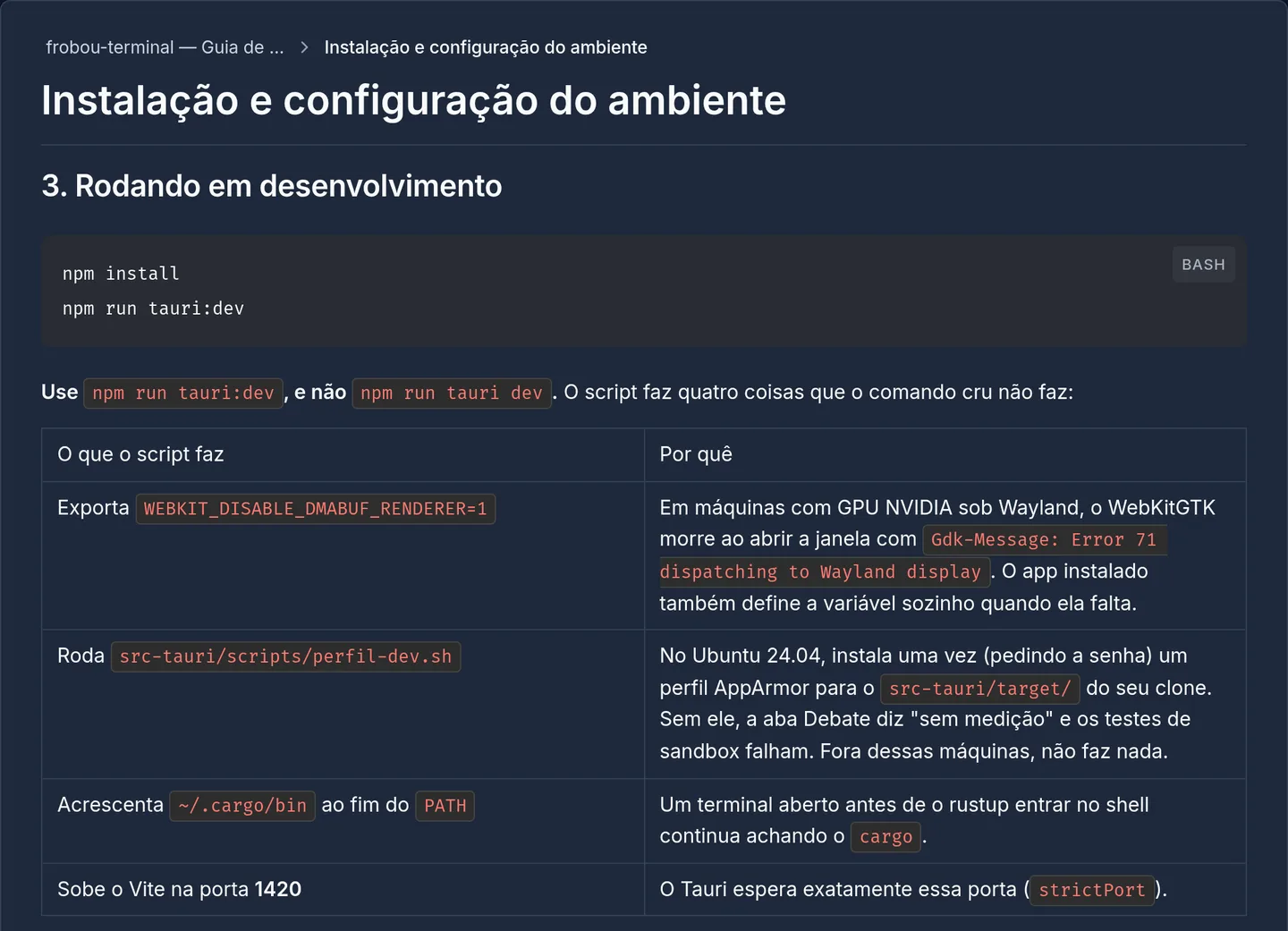
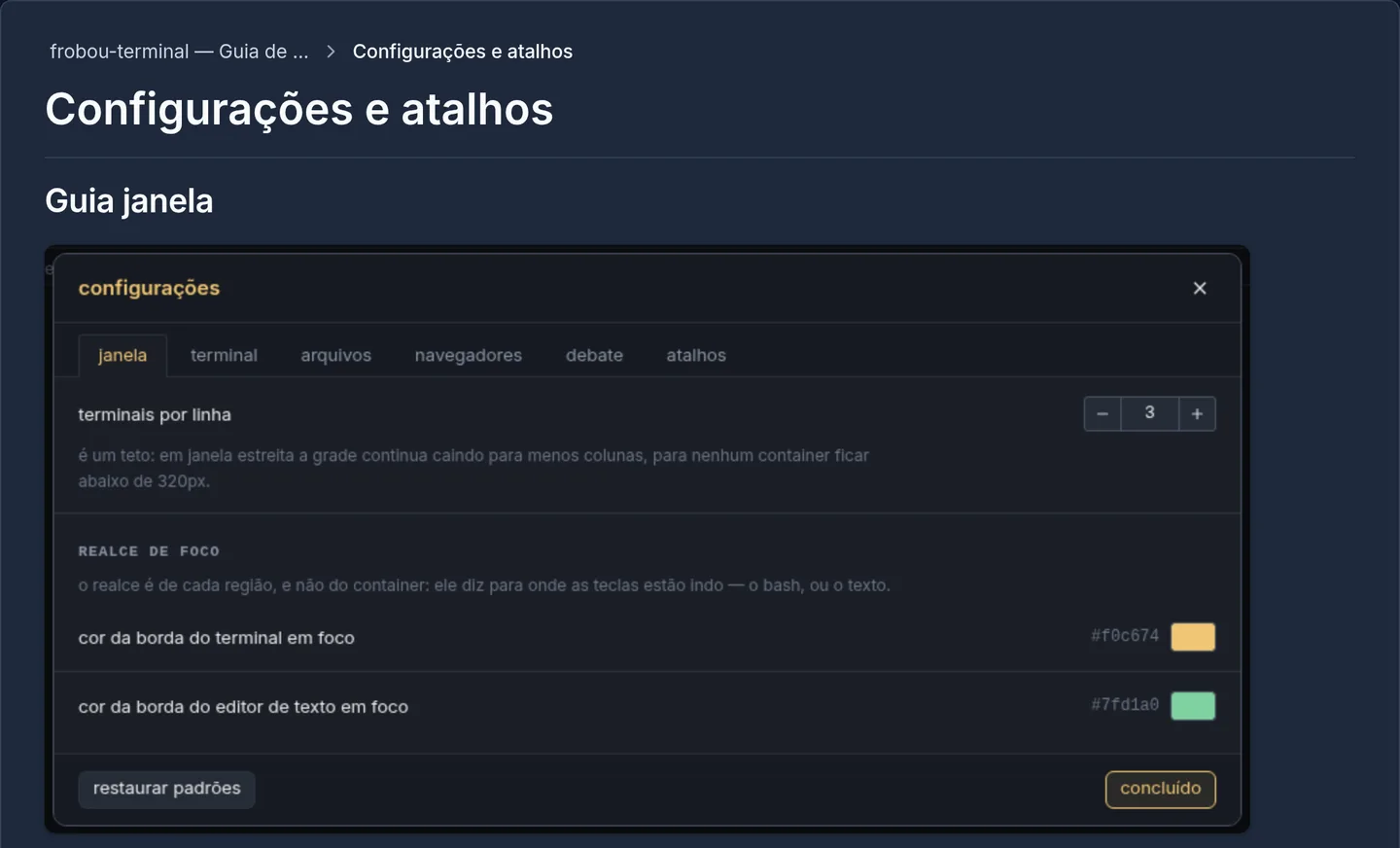
The frobou-terminal user guide, in the image at the top, was written by an agent through that MCP: one document and ten subdocuments, with 27 screens of the app.
How it is built
The interface is Angular 22, with standalone components and signals, and the editor is TipTap. The backend is NestJS 11 with TypeORM on PostgreSQL 16, with the API described in Swagger. The MCP turns the agents' Markdown into editor blocks and the blocks back into Markdown. The interface has Portuguese and English, light and dark themes and keyboard shortcuts.
It runs in Docker, in a development stack with live reload and a production one, both published, by default, only to the machine they run on. Besides the unit tests, there are end-to-end tests with Playwright in the interface and with Supertest in the backend.
10
MCP tools for agents, and none of them deletes anything
0
writes through MCP without the user's confirmation
2000+
test cases across the interface and the backend